
Short answer
Children need mittens that are warm, flexible, durable, and easy to put on. Mittens are warmest and easiest for the youngest children, while gloves suit children who want to manage zippers and ski poles themselves. Wrist straps, a cuff that can be tightened, and reinforcements where children wear things out make a big difference in everyday life. Our children's glove Videmyr is built like an adult glove, with the same details as our adult models.
Children do not get cold in the same way as adults. They get cold suddenly. One moment they are digging in a snowbank and notice nothing, the next they are standing in the hallway crying because their fingers hurt.
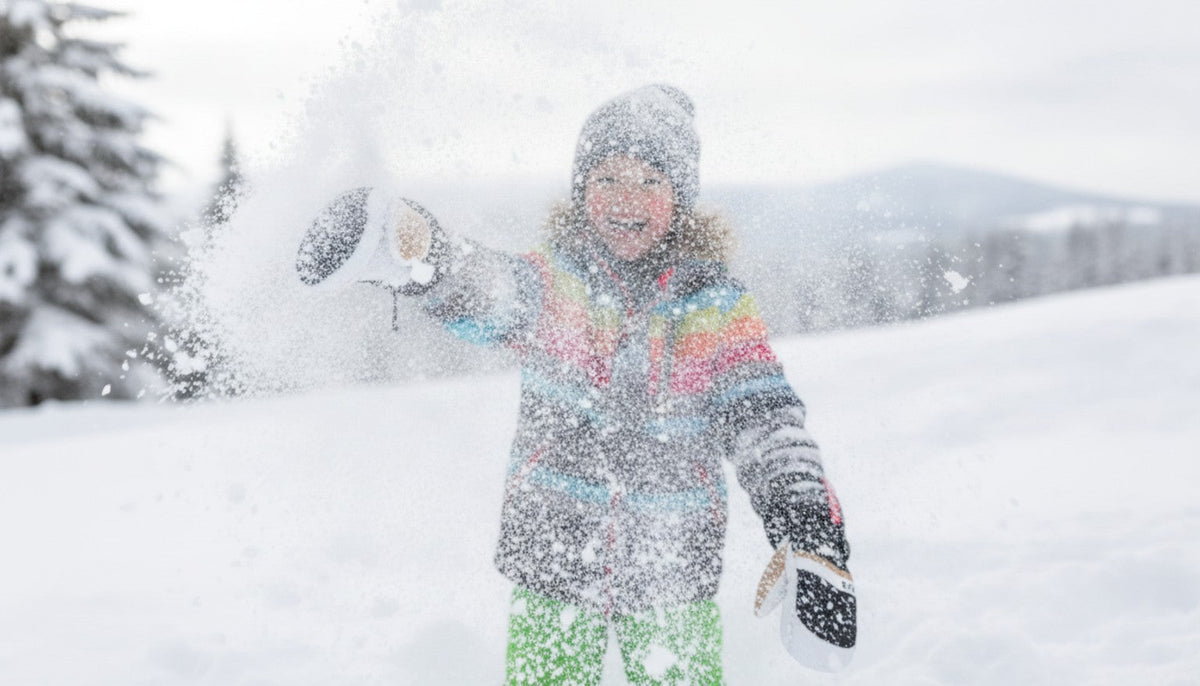
Adults move through snow. Children are in the snow. They lie in it, dig in it, throw it, and taste it. They crawl forward on their knuckles, brake the sled with their hands, and take off their mittens twenty times per recess. This places completely different demands on a mitten than most children's mittens are designed to meet.
That is why Videmyr is built like an adult glove
Children's mittens are often bought as disposable items - cheap, one pair per season, and then new ones. We wanted to do the opposite. Videmyr was developed in Norrbotten for real outdoor activities: the schoolyard, the sledding hill, and the ski slope. It has the same materials and the same carefully considered details as our gloves for adults. Nothing has been left out because it is a children's glove.


1. The runny-nose brake
It may sound funny. But anyone who has stood on a sledding hill with a child knows that noses run in the cold - all the time. A softer section on the thumb is designed for exactly that, just like on our adult models. It saves a few jacket sleeves.
2. The goggle scraper in the outward-facing seam
On the ski slope, goggles get covered in snow and fog up. The thumb seam faces outward and works as a scraper, so the child can remove snow and ice without taking off the mitten. A small detail - but one that means a day of skiing is not interrupted in the lift queue.
3. Wrist straps
A child takes off their mittens. Often. To pick something up, to blow on a friend, because it itches. And then the mitten is left in the snow. With the wrist straps, the mitten stays attached at the wrist. It is there when the hands get cold again - and it does not get left on the schoolyard. The straps are included.
4. Warm and flexible, with removable PrimaLoft® lining
The inner glove is made of PrimaLoft® and is removable, just like in our adult gloves. It provides warmth without making the mitten so thick and stiff that the child cannot grip. It can also be removed and dried separately, so the mitten is ready again the next morning.
5. Reinforced where children cause wear
The outer shell is made of Cordura and goatskin - the same materials as in our adult gloves, chosen to withstand wear from play. The mitten is reinforced to handle what children put it through: snowbanks, sledding hills and climbing frames, day after day.
6. A cuff the parent can put on
The cuff is designed to be easy for an adult to put on - even on a child who will not stand still. An adjustable wrist buckle closes the gap so that snow stays out.


Mitten or finger glove - advantages and disadvantages
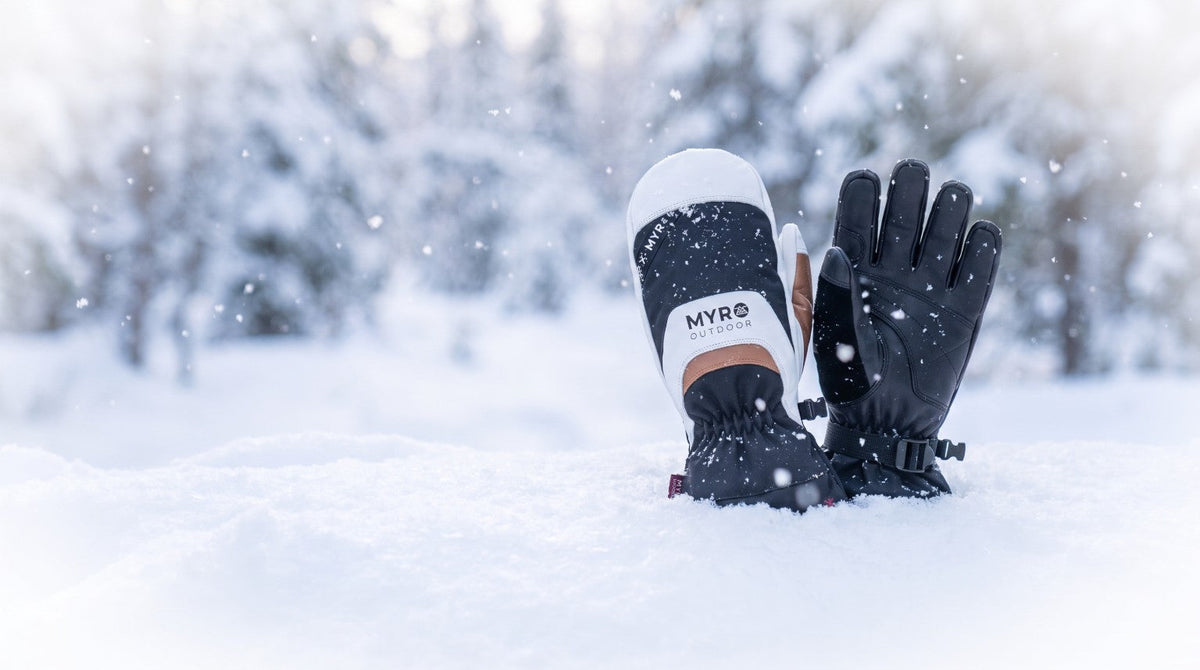
Videmyr is available in two versions, and the choice depends on the child's age, what they will be doing outdoors and how cold it is.
| Videmyr Mitten | Videmyr Finger | |
|---|---|---|
| Advantages | Warmest - the fingers warm each other. Easiest to put on, even for the smallest children. Best for long days in the cold and on the sledding hill. | Better grip on ski poles, sled ropes and snowballs. The child can manage zippers, buttons and helmet buckles independently. |
| Disadvantages | Less finger dexterity. More difficult to manage zippers and small items without taking the glove off. | Not as warm. May be harder for the youngest children to put on - five fingers have to find their way into the right places. |
| Temperature rating | 0 to -25 °C | +5 to -15 °C |
| Sizes | 5-6, 7-9 and 10-12 years | 5-7, 7-9 and 10-12 years |
| Best suited | Youngest children, cold days and children who get cold easily | Older children, skiing and milder winter days |
A simple way to think about it: the younger the child and the colder it is, the more the mitten is the right choice. The more the child wants to manage independently - and the milder it is - the more the finger glove is the right choice. Many families up here have both: the mitten for the coldest days and the finger glove for skiing and spring.
Dry hands - the most important thing of all
Most often, it is not the cold that makes children freeze, but that the mittens have become wet. Videmyr has no waterproof membrane. It is designed to withstand getting damp and to be dried again: the Cordura and goatskin outer shell resist snow, especially when the leather is waxed, and the inner glove can be removed and dried separately for the next day.
The best advice we can give parents is therefore simple: two pairs. One to wear, one to dry. This is especially true for children who spend time outdoors both at preschool and afterwards. Read more about the difference between membranes and other constructions in Waterproof glove or without a membrane?
The size - rather a little too big than a little too small
A mitten that is too small is a cold mitten, just as with adults. It compresses the insulation and fingers. And a child wearing gloves that are difficult to put on will refuse to wear them. Children grow at different rates, so measure the hand if possible and choose slightly too large rather than slightly too small. Learn more about fit in How a Winter Glove Should Fit.
Dry and care for children's mittens
- Remove the inner glove and let the mitten and lining air-dry separately at room temperature.
- Avoid radiators, drying cabinets and tumble dryers - high heat damages the leather.
- The inner glove can be machine-washed at 30 °C on a gentle cycle. Hand-wash the leather shell carefully with a mild leather cleaner.
- Wax the leather with Leather Grab Wax after washing and a few times per season. This will help the mitten last longer and resist snow and moisture.
Learn more about care in Leather Gloves in Winter - Goatskin, Wax and Drying.
Checklist: how to choose children's winter gloves
- Mittens for the youngest children and coldest days, gloves for children who want to grip on their own
- Warm but flexible - the child should be able to grip
- Wrist straps so the mitten does not get lost
- Nose wipe and goggle scraper - they sound like small details until you need them
- Reinforced materials where children cause wear
- Cuff that is easy to put on and can be tightened
- Removable lining that can be dried by the next day
- The right size, with a little room to spare
Frequently asked questions
Which children's mittens are warmest?
Insulated mittens that fit properly and are kept dry. Videmyr Mitten has a temperature rating of 0 to -25 °C.
Should my child wear mittens or gloves?
Mittens for the youngest children and cold days - they are the warmest and easiest to put on. Gloves for older children who want to manage zippers and ski poles themselves, and for milder days.
Is Videmyr waterproof?
No. Videmyr has no waterproof membrane. The Cordura and goatskin shell resists snow, and even more so if the leather is waxed, but the mitten will become damp during long periods in wet snow and slush. The removable lining makes it easy to dry again.
What age is Videmyr suitable for?
Videmyr is designed for children approximately 5-12 years old and is available in three age-based sizes.
Read more
- How to choose winter gloves - the complete guide
- Mittens or gloves - which are warmer?
- Why do your hands get cold?
Written by David Andersson, founder of Myr Outdoor. Myr develops gloves in Norrbotten, where winter lasts approximately seven months of the year and the products are tested in real-world use.