
Short answer
A mitten is warmer than a glove made of the same materials and with the same insulation. The fingers share a warm compartment, warm one another, and have less surface area that radiates heat. A glove instead provides better grip and dexterity. Choose a mitten when warmth is most important, and a glove when you often need to use your fingers.
Up here, it is not unusual to have both in your pack. Mittens on when it is cold and you are standing still. Gloves out when something needs to be tied, loaded, adjusted, or tightened. That really says it all about the choice: there is no glove that is best at everything. But there is one that is best for what you are going to do.


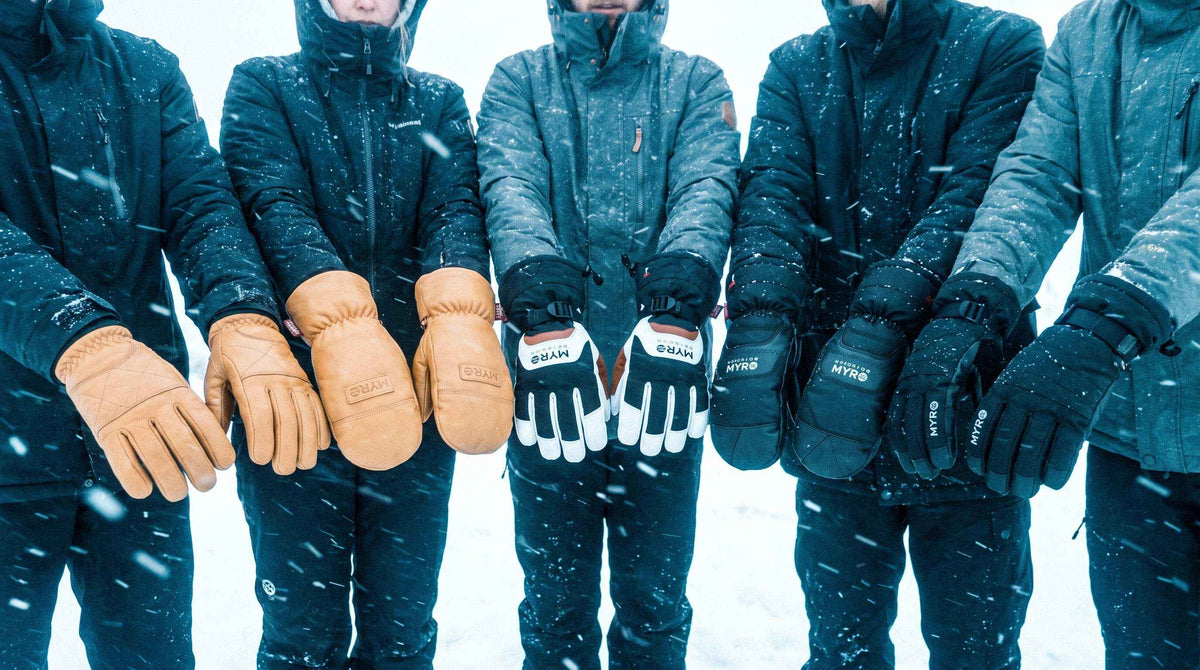
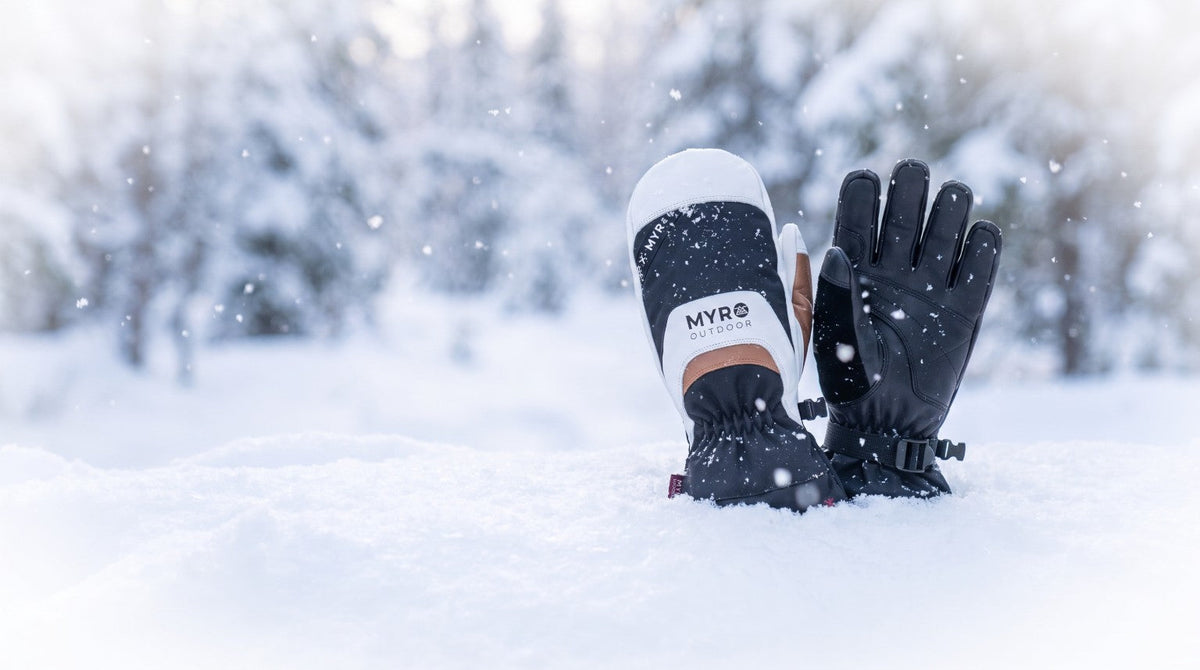
The image above shows the difference quite clearly in figures. Nordals and Nuolja are made in the same series, with the same Cordura and goatskin shell and the same type of removable PrimaLoft® lining. Yet the mitten has a temperature rating that is ten degrees lower. It is the shape that makes the difference.
Why is a mitten warmer?
It comes down to three things working together.
1. Less surface area exposed to cooling
Heat leaves the glove through its surface. Five separate finger tunnels have a considerably larger surface area exposed to the cold than one shared compartment for four fingers. A smaller surface area means less heat is lost - with the same insulation.
2. The fingers warm each other
In a mitten, the fingers rest against each other and share the same air volume. A finger that is a little colder receives warmth from its neighbor. In a glove, each finger stands alone in its own cold tunnel. The little finger, which is the smallest and has the least muscle, often gets cold first.
3. More room for insulation where it is needed
Between the fingers in a glove, there are seams and thin areas where the insulation cannot reach. In a mitten, the insulation can form a more continuous layer across the entire back of the hand and around the fingertips.
From our product development team
Nordals and Nuolja were developed together with mountain guides and reindeer herders - people who keep their hands out in the cold all day at work. Their requirements were clear: warmth that lasts all day, and a grip that can handle poles, ropes, handles, and snowmobile handlebars. That is why the grip surfaces are reinforced with double layers of goatskin, while the back of the thumb is covered in soft suede. It is used for the things you actually need it for outdoors: wiping glasses, a GPS screen on the snowmobile, or the tip of a cold nose.
What do you lose with a mitten?
Dexterity. With mittens, it is more difficult to:
- fasten buttons, pull zippers, and tie knots
- handle small objects such as keys, cartridges, or fishing lures
- use a phone, camera, and GPS
- grip narrow handles with full control
The simplest way to solve this is to wear a thin liner glove underneath. Then you can pull off the mitten for a quick task without leaving your hands completely bare. Our merino wool liner Morken has an opening for the index finger, so you can access your phone or trigger without taking it off.
When is a five-finger glove the right choice?
A five-finger glove is the right choice when you move around more, need to grip things frequently, and cold is not the biggest problem. That does not mean a five-finger glove has to be cold. A well-made five-finger glove with proper insulation, a windproof shell, and a liner that can be dried will keep your hands warm far down the thermometer, especially while moving.
That is why we developed Nuolja as one of our warmest five-finger gloves, with a removable PrimaLoft® liner and an extra-wide cuff that fits over most down jackets. For those who want a classic winter glove in all leather, Abisko is a five-finger glove made from full-grain goat leather for days down to –20 °C.
Mitten or five-finger glove - how to choose
| Choose a mitten if… | Choose a five-finger glove if… |
|---|---|
| you stand or sit still in the cold for long periods | you move around a lot and get warm |
| you ride a snowmobile or your fingers get cold easily | you need to handle equipment frequently |
| the temperature is often below –20 °C | it is cold, but not extreme |
| warmth is more important than precision | grip is more important than maximum warmth |
Are there any compromises?
Yes, a few:
- Mitten with a liner underneath. The most flexible solution. Warmth when you need it, fingers when you need them.
- Change the liner during the day. In Nordals and Nuolja, the liner is removable. You can switch to a dry Arctic Inner in the middle of the day, or add the waterproof wool liner Arctic Wool when the weather changes.
- Two pairs. It sounds simple, but many people up here do this. One pair for the cold, one for work.
Frequently asked questions
How much warmer is a mitten?
It depends on the construction, insulation, and fit. In our own range, the Nordals mitten is rated to –30 °C and the Nuolja five-finger glove to –20 °C, with the same type of shell and lining. This gives a good indication of how much difference the shape makes.
Can you ride a snowmobile with mittens?
Yes, and for many people it is the best choice because you sit still in the wind while riding. What matters is that the grip surfaces are durable and that the glove is not so thick that gripping the handlebars becomes cramped. Read more in our guide to snowmobile gloves.
Is it called a mitten or a glove?
Both are used. In everyday speech, many people use "vante" for both mittens and gloves, especially in the north. In retail, "glove" is often used for a five-finger glove, while "thumb glove" or "mitten" is used for the other type.
Read more
- How to choose winter gloves - the complete guide
- Why do your hands get cold?
- How to build a warm winter glove
Written by David Andersson, founder of Myr Outdoor. Myr develops gloves in Norrbotten, where winter lasts about seven months a year and the products are tested in real-world use.