
Short answer
Snowmobile gloves must handle wind chill, and wind chill makes the cold significantly worse: -20 °C at 60 km/h feels like around -36 °C to exposed skin. Choose an insulated glove with a windproof shell, a wide cuff that goes over the jacket, and reinforcement where the handlebar causes wear. For most snowmobile trips, we recommend a warm finger glove - you need your fingers for the throttle, brake, visor, and equipment. Our Nuolja was developed specifically for that.
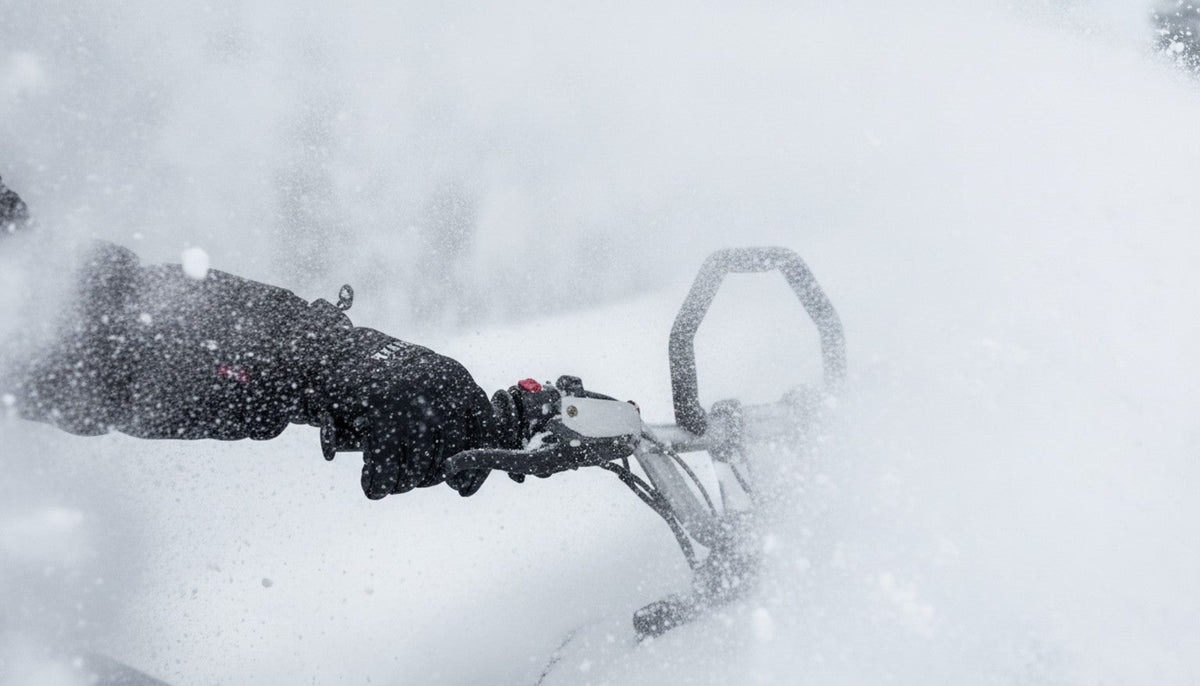
A snowmobile is a special place for your hands. You sit still, have wind coming straight at you, and hold on to a cold handlebar for hours. Your thumb rests on the throttle all day. And when something goes wrong - the snowmobile gets stuck, a belt needs tightening, a hole needs drilling - you have to get off and dig in the snow with the same gloves.
It's hard to find a situation that places higher demands on a glove. That's why it's also where we have done the most testing.
Born in the mountains - that's why Nuolja is built for snowmobiling
We developed Nuolja over many seasons together with reindeer herders - people who ride snowmobiles more than almost anyone else, in the mountains, in all weather, and often for entire days at a time. Every detail below is there because one of them was missing it.

1. A cuff that goes over the jacket - and keeps out the snowstorm
On a snowmobile, the wrists are where cold air gets in. Wind finds its way into the gap between glove and jacket, and in a snowstorm, snow is forced in the same way. That's why Nuolja has an extra-wide cuff that goes over the jacket sleeve, even with a thick down jacket. It closes the gap from the outside, so neither wind nor snow can get in - not even when you stretch your arms forward toward the handlebars.
2. A roughened thumb surface for goggles and GPS
Ice and fogging on goggles, visors, and GPS screens are everyday occurrences on a snowmobile. On the outer part of the thumb is a roughened surface designed to scrape it away, so you don't have to take off your glove in the middle of a ride or during a cold break.
3. The snot wiper
It may sound funny. But at -25 °C and with wind chill from speed, your nose runs, and it doesn't stop just because you're sitting on a snowmobile. The soft material snot wiper on the thumb is made for exactly that. Anyone who has ridden all day without one knows why it's there.
4. A high-performance PrimaLoft® lining for warmth and technical riding
Snowmobiling is not just about sitting still. In rough terrain, you stand up, shift your weight, grip and work with your hands - and then you get warm and sweat. Then you stop, and the moisture turns cold. That is why Nuolja has a removable PrimaLoft® liner that we have put a great deal of thought into: it should provide warmth when you are sitting still in the wind chill, transport moisture away when you are riding technical terrain, and be removable for drying until the next day. Exactly how the liner is constructed, we are keeping to ourselves.
5. Reinforced precisely where the grip causes wear
A snowmobile handlebar wears the same areas every day. During the seasons we spent with reindeer herders, we saw exactly where the gloves wore through - and that is where Nuolja has reinforcements with double layers of goatskin, in the palm and on the fingers where they rest against the grip. This is not general reinforcement. It is a map of how a hand holds a snowmobile.


And one detail for those who look closely: Nuolja features a trail marker cross. It is the same cross found on the posts along the winter trails in the mountains, and the one many of us have followed through snowstorms when visibility is down to a few metres. It does not make the glove warmer. But it is a reminder of what the glove was made for.
The wind chill – the cold you create yourself
On a windless day, the thermometer may read –15 °C and the conditions may feel calm. But on a snowmobile, you create your own wind. Here is what the wind chill does to the cold for unprotected skin:
| Air temperature | 20 km/h | 40 km/h | 60 km/h | 80 km/h |
|---|---|---|---|---|
| –5 °C | –12 | –14 | –16 | –17 |
| –10 °C | –18 | –21 | –23 | –24 |
| –20 °C | –30 | –34 | –36 | –38 |
| –30 °C | –43 | –48 | –50 | –52 |
Wind chill calculated using the international formula (JAG/TI), rounded. Values apply to bare skin.
A glove of course protects the skin. But the wind affects the glove too: it blows through loosely woven materials, gets in at the wrist, and cools the surface so heat disappears faster. That is why a glove that works perfectly well on a walk can be far too cold on a snowmobile.
What a snowmobile glove needs
A windproof shell
The most important thing of all. Leather, tightly woven fabric such as Cordura, or a membrane. A knitted or loosely woven glove is almost useless at 60 km/h. Nuolja has a shell made of Cordura and goatskin.
Plenty of insulation on the back of the hand
The back of the hand takes the brunt of the wind chill. That is where insulation is needed most, and where it is not compressed by gripping the handlebars.
Right in the palm of your hand
A glove that is too thick in the palm makes you grip the handlebars more tightly. Then the insulation gets compressed anyway, and your hands become tired. If you have heated grips, a thick palm also makes it harder for the heat to reach your hand.
A thumb grip that can handle the throttle
Most snowmobiles have a thumb throttle. Your thumb presses against the throttle control all day, with the insulation compressed between your thumb and the cold lever. That is one reason reinforcements and insulation must be positioned correctly - not merely be present.
Finger glove or mitten on a snowmobile?
A mitten is warmer with the same materials because the fingers warm one another. But on a snowmobile, you use your hands more than you might think: you control the throttle, apply the brake, adjust the visor, scrape goggles, and handle your phone, maps, straps, and buckles. In a mitten, all of that is clumsier, and you take the glove off more often - which costs more warmth than you gain.
That is why we recommend a warm finger glove for most snowmobile trips. Nuolja is rated to -20 °C. For the coldest days, it can be paired with our Arctic Wool wool liner, made of Norwegian merino wool and PrimaLoft®, which provides extra warmth and a waterproof membrane.
A mitten such as Nordals (-30 °C) is a good choice if you ride long stretches in severe cold, sit still most of the time, or get cold fingers very easily.
Read more about the choice in Mittens or finger gloves?
Waterproof or not?
While riding itself, in dry cold, the glove primarily needs to be windproof. But snowmobile days rarely consist of riding alone. The snowmobile gets stuck and has to be dug out. Snow has to be shoveled away from the sled. Holes have to be drilled, and fish pulled up. Then the glove is in full contact with snow, and the snow melts against warm hands.
You have three options:
- Breathes best in dry cold: Nuolja without a membrane, with a removable PrimaLoft® liner that is easy to dry.
- Waterproof when you need it: Nuolja paired with the Arctic Wool wool liner, which has a 100% waterproof membrane and provides extra warmth.
- Always waterproof: Arvidsjaur Mitts, a mitten with a waterproof membrane beneath the leather, for those who mostly spend time in wet snow.
Two pairs - how many people up here do it
One pair of warm riding gloves that you keep dry, and one pair of work gloves for what happens when the snowmobile is parked. Put the riding gloves inside your jacket or in a bag when digging, fishing, or loading. That way, you have dry, warm gloves when it's time to ride home - and that's usually when you need them most. An extra dry Arctic Inner lining serves the same purpose and takes up less space.
Five tips for warmer hands on a snowmobile
- Put your gloves on indoors. Warm hands in warm gloves retain heat. Cold hands in cold gloves rarely warm up on their own.
- Relax your grip occasionally. A tense grip restricts blood flow and compresses the insulation. Relax your hands on the straight stretches.
- Protect your wrists. Pull the cuff over the jacket sleeve and check that there is no gap in the riding position.
- Keep the gloves dry. Take off your riding gloves when digging or working.
- Dry them properly. Remove the lining and let everything air-dry at room temperature until the next ride - never on the stove in the cabin or in a drying cabinet. Read more about drying and care.
Frequently asked questions
What are the best snowmobile gloves?
For most people: a warm five-finger glove with a windproof shell, a wide cuff over the jacket, and reinforcement where the handlebars cause wear. That's exactly what we built Nuolja for, together with reindeer herders. For long rides in severe cold, a mitten like Nordals may be warmer.
Why does your thumb get cold on a snowmobile?
Because it presses against the throttle the whole time. The insulation between the thumb and the cold lever is compressed, and the thumb gets less blood flow. A glove with a well-insulated thumb grip and heated grips on the throttle helps.
How cold does it get on a snowmobile?
Much colder than the thermometer shows. At 60 km/h, -20 °C feels like approximately -36 °C on bare skin, according to the wind chill formula.
Do snowmobile gloves need to be waterproof?
Not for riding in dry cold, but for everything around it - digging out the snowmobile, ice fishing, and wet snow - waterproofing is a major advantage. With the Arctic Wool lining, Nuolja is waterproof when you need it.
Read more
- How to choose winter gloves - the complete guide
- How warm should a winter glove be?
- Waterproof gloves or no membrane?
Written by David Andersson, founder of Myr Outdoor. Myr develops gloves in Norrbotten, where winter lasts about seven months of the year and the products are tested in real-world use.